
Air Navigation Classes for Commercial Pilot License (CPL)
Air Navigation is one of the most important and technical subjects in pilot training. At Cockpit Classes, we train aspiring pilots to plan, monitor, and execute flights accurately using navigation principles required for DGCA and international CPL programs.

What is Air Navigation?
Air Navigation is the science of planning, directing, and controlling an aircraft’s movement from one point to another safely and efficiently. It helps pilots determine position, track, distance, time, fuel requirements, and altitude throughout the flight.
This subject forms a core part of the CPL syllabus and plays a crucial role in both theoretical exams and real-world flight operations.
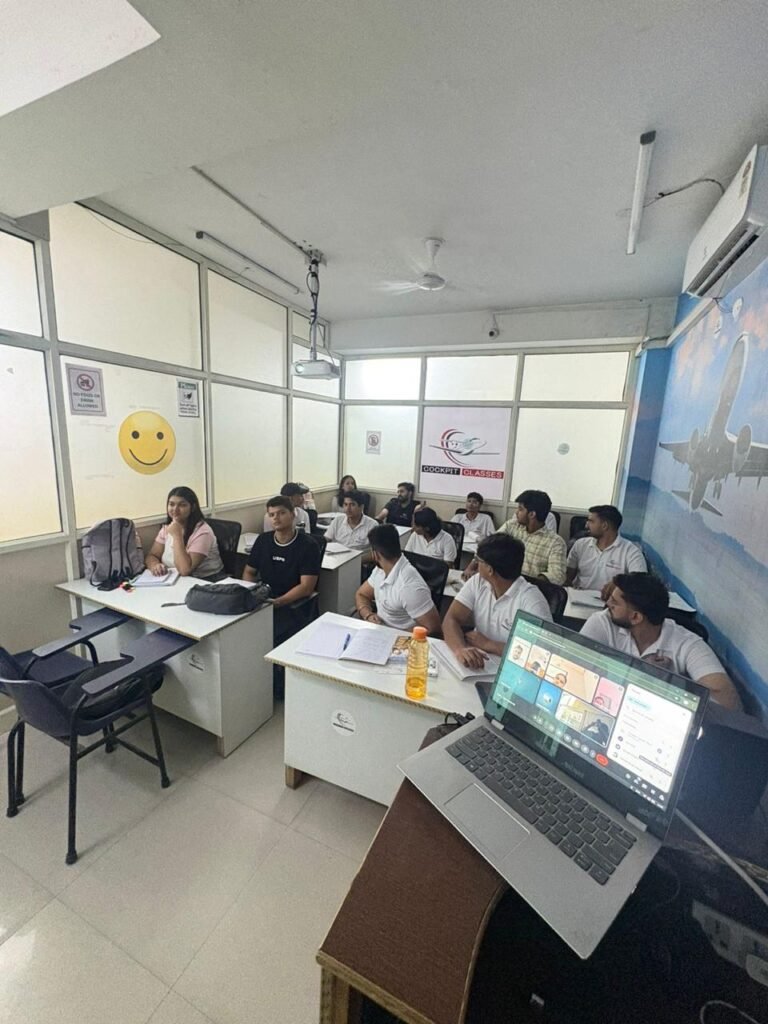
Why Air Navigation is Important for Pilots
Accurate navigation is essential for flight safety and efficiency. A professional pilot must be able to navigate under both visual and instrument flight conditions.
At Cockpit Classes, students learn how navigation helps in:
Accurate flight planning and route selection
Fuel, time, and distance calculations
Maintaining correct headings and tracks
Handling diversions and alternates
Operating safely in controlled and uncontrolled airspace
Topics Covered in Air Navigation
Our Air Navigation curriculum is fully aligned with DGCA standards and international aviation requirements.
Key topics include:
Basics of navigation and Earth geometry
Latitude, longitude, great circle & rhumb line
Time calculations and UTC conversions
Speed, distance & fuel calculations
Wind triangle and drift correction
Dead reckoning navigation
Pressure, density & altitude calculations
Navigation errors and limitations
Flight Planning & Navigation Calculations
Students are trained to perform complete flight planning calculations required for CPL examinations and actual flying.
Training includes:
True airspeed (TAS) & ground speed calculations
Wind correction angle (WCA)
Track vs heading determination
Fuel consumption & endurance
Estimated time of arrival (ETA) calculations
Practical examples are used to build accuracy and speed.
How Cockpit Classes Teaches Air Navigation
Air Navigation is taught using a step-by-step, concept-driven approach to simplify even the most complex calculations.
Teaching methodology includes:
Classroom-based conceptual teaching
Numerical problem-solving sessions
DGCA exam-oriented practice
Doubt-clearing & revision classes
Regular assessments and mock tests
Students are trained to think logically and calculate confidently.
Benefits of Studying Air Navigation at Cockpit Classes
After completing Air Navigation training, students will be able to:
-
Perform accurate navigation calculations
-
Plan cross-country flights confidently
-
Apply navigation knowledge in real flying
-
Improve speed and accuracy in DGCA exams
-
Develop strong situational awareness as pilots
This course is ideal for:
-
CPL aspirants (India & abroad)
-
Student pilots
-
Candidates preparing for DGCA exams
-
Aspiring professional pilots